
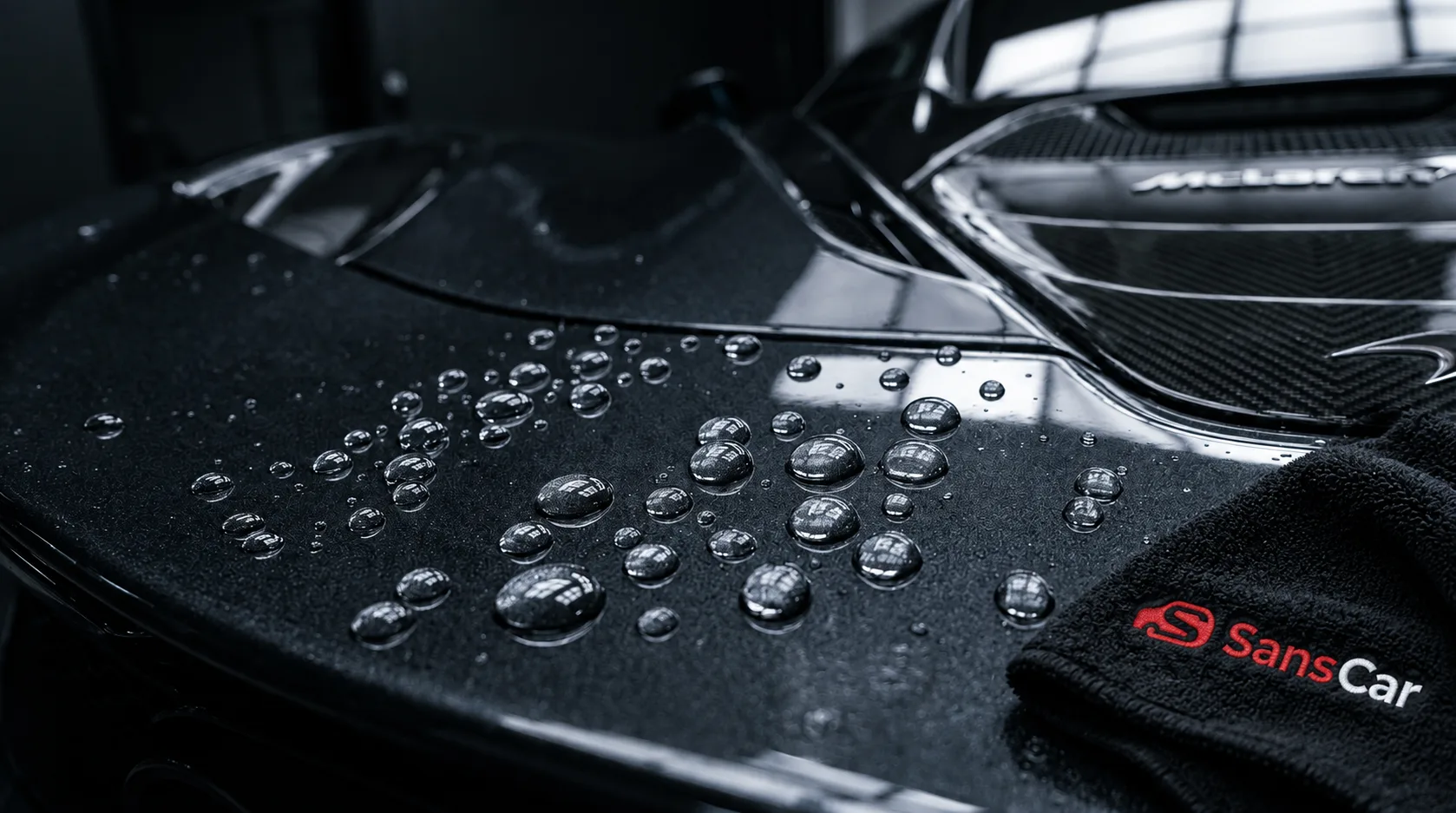
Modern ceramic coatings represent a fundamental leap from traditional carnauba waxes and synthetic polymer sealants. Understanding how liquid polysilazanes cross-link with polyurethane clear coats provides clarity on what genuine surface preservation delivers.
01 / The Thermal Limitations of Organic Waxes
For decades, natural carnauba wax was hailed as the standard of paint enhancement. However, thermodynamic testing reveals clear boundaries: natural carnauba softens around 65°C and breaks down above 80°C. In hot climates, dark automotive clear coats routinely record surface temperatures exceeding 85°C in direct midday sun. Within a few weeks, organic wax layers liquefy and evaporate, leaving factory clear coats exposed to acid fallout, mineral etching, and UV degradation.
02 / Polysilazane & SiO2 Crystallization
True ceramic coatings belong to the organosilicon polymer family. In liquid form, they comprise inorganic polysilazane molecules suspended in volatile carrier solvents. When applied to machine-corrected paint, these nanoscale molecules penetrate the microscopic pores of the factory clear coat.
As the solvent carrier flashes, ambient moisture triggers a cross-linking hydrolysis reaction. This permanently transforms the liquid into a three-dimensional Silicon Dioxide (SiO2) crystalline matrix measuring 2 to 3.5 microns in thickness. Once cured, it creates a covalent bond that cannot wash away with high-pH road detergents or petroleum degreasers.
03 / Fluid Dynamics & The 112° Contact Angle
Extreme hydrophobicity is the hallmark of a genuine ceramic matrix. The water contact angle measures the interface between a droplet and the vehicle surface. Factory clear coats exhibit a contact angle around 70° to 75°, causing water to sheet flatly and deposit hard calcium minerals as it evaporates.
A professional ceramic coating elevates the contact angle to 112° to 118°. Water forms near-spherical beads with minimal surface adhesion. As the vehicle drives at highway speeds, airflow displaces these beads, carrying away loose surface grit in what is scientifically termed the Lotus Effect.
04 / Clean-Room Application Protocol
At SansCar in Handewadi, coating installation requires dust-managed conditions. After multi-stage rotary and random-orbital paint correction eliminates swirls and oxidation, the paint undergoes thorough isopropyl alcohol residue stripping. Panels are then methodically coated in overlapping cross-hatch sections and allowed to bond under controlled curing conditions.
To explore ceramic coating options tailored to your car's paint condition, visit our ceramic & graphene coatings page or schedule an inspection at the studio.