
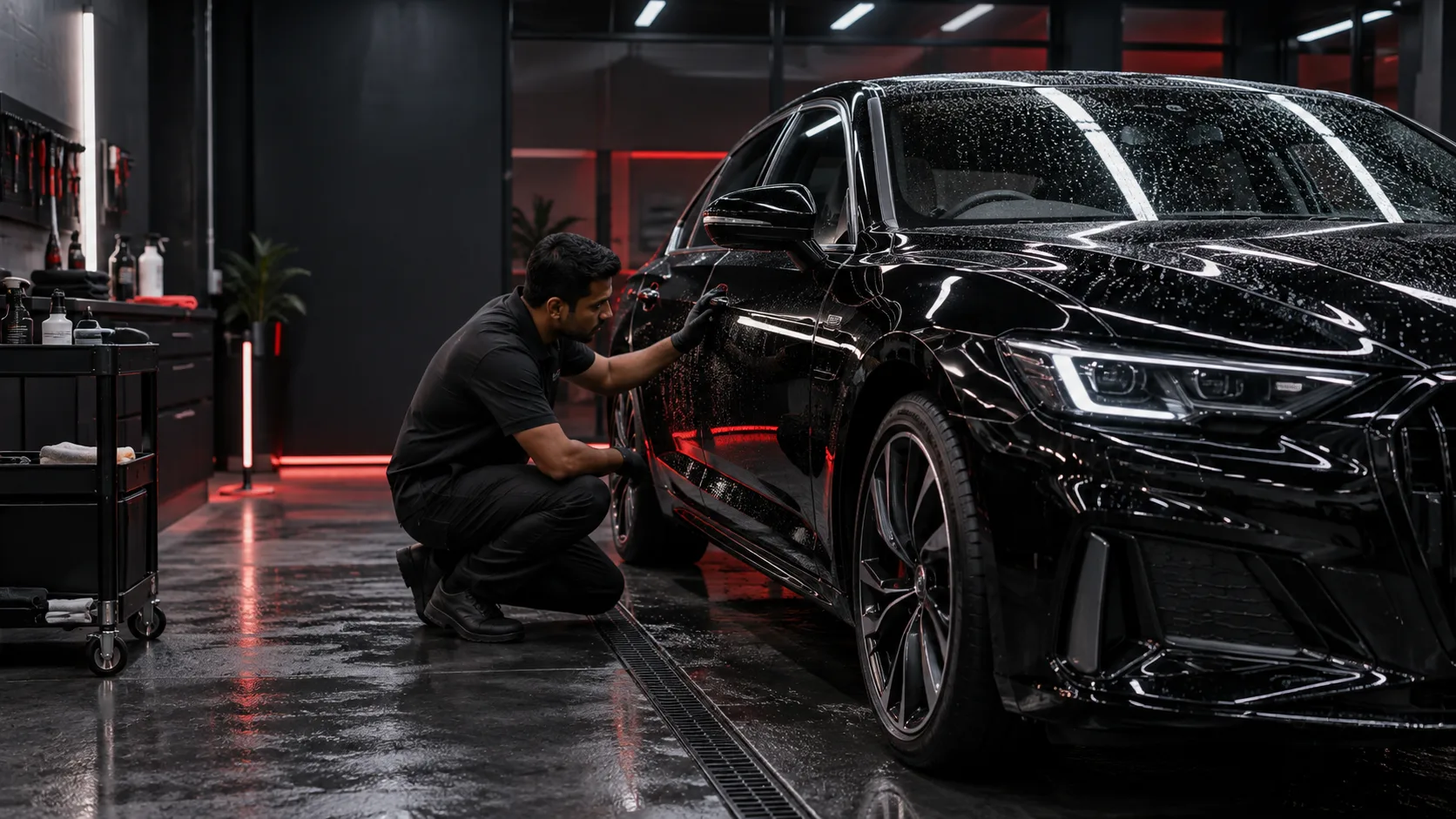
A 2022 Deep Black Metallic Sedan arrived at SansCar in Handewadi with heavy visible swirl marks, wash marring and noticeable water spotting across the top panels. Under normal daylight the finish looked dull, hazy and robbed of reflection. Under inspection lighting, the paint showed dense circular swirls and micro-marring from typical apartment washes. The goal was not to chase every mark down to bare metal. It was to improve optical clarity safely, preserve the available clear coat thickness and apply durable ceramic protection suited to Pune driving.
Case Study Summary
| Field | Verified Job Detail |
|---|---|
| Vehicle | 2022 Deep Black Metallic Sedan |
| Owner location | Handewadi / Undri, South Pune |
| Main concern | Severe circular swirl marks, dull reflection and stubborn mineral spots |
| Inspection finding | 105 to 118 microns average clear coat; heavy micro-swirls on bonnet and roof; shallow wash scratches on flanks; one deeper rock chip on lower front bumper |
| Agreed scope | Citrus pre-wash, iron fallout decontamination, clay bar treatment, 2-stage machine paint correction, panel wipe and professional 9H ceramic coating application |
| Time in studio | 2 full working days (16 labor hours) |
| Protection applied | Professional multi-layer hydrophobic ceramic coating on all painted panels, lights and exterior trim |
| Documented result | Restored jet-black gloss and sharp mirror reflections; wash swirls eliminated; deep stone chip touched up safely rather than over-thinned |
The condition at intake
The first step was an in-person walk-around with the owner. We recorded existing stone chips, repainted areas, minor parking scratches and trim condition before work began. This protects both the vehicle and the clarity of the job plan. The owner explained that the car is normally parked in a semi-open society stilt in Undri, commutes through Handewadi and Kondhwa, and had been wiped down daily with borewell water and shared dry cloths. Those details helped us understand exactly how the defects had developed and how the finish would need to be maintained afterwards.
A careful wash removed loose road grime so the underlying clear coat could be evaluated accurately. After chemical decontamination, the team inspected the panels under controlled multi-spectrum lighting and recorded paint-thickness readings, areas of thin factory paint along swage lines, and deeper scratches that could not safely be eliminated. This is the point at which the proposed correction changed from an assumption into an agreed scope.
What paint correction can and cannot do
Paint correction uses controlled machine polishing and diminishing abrasives to level micro-ridges in the clear coat that scatter light. The safe result depends on paint depth, defect depth, previous polishing history and panel shape. Light wash marks, spider webbing, haze and some oxidation can improve substantially. A deep scratch that catches a fingernail, exposed primer or failing clear coat requires automotive paint repair rather than compounding. Preserving clear coat integrity for future years is always more important than chasing every isolated mark. Learn more about our specialized paint correction process.
The agreed correction plan
- Pre-wash and contact wash using pH-neutral foam and a two-bucket method to strip loose grime without surface drag.
- Chemical and mechanical decontamination using iron-remover spray followed by fine synthetic clay to extract bonded industrial fallout.
- Masking of sensitive rubber trim, emblems, sharp body creases and adjacent plastics.
- Test section on the bonnet to select the least aggressive effective pad and compound combination.
- Two-stage precision machine correction: rotary/forced-rotation cutting stage to level defects followed by dual-action refining for optical gloss.
- Panel wipe with isopropyl alcohol to remove polishing oils and inspect bare paint under consistent LED lighting.
- Application of professional ceramic coating to all corrected painted surfaces, light clusters and trim.
- Controlled curing in the studio, final inspection and detailed handover guidance.
Why a test section matters
Different clear coats respond differently to the same polishing combination. German, Japanese and Indian manufactured paints have distinctly different hardness profiles. A test section shows whether the planned process produces meaningful defect removal without unnecessary clear coat removal. For this sedan, a 50x50 cm test spot on the bonnet showed that a medium-firm foam pad with a micro-abrasive compound cleared 85%+ of micro-swirls cleanly without requiring aggressive wool cutting, leaving ample clear coat for the finishing pass.
Correction and inspection
The team worked systematically panel by panel, checking the finish between passes with inspection lights instead of relying on a single final reveal. Extra care was taken around panel edges, body lines and badges where paint is naturally thinner. The aim was consistent clarity across the car rather than an aggressive result on one flat panel and uneven haze elsewhere.
After correction, multi-angle inspection showed deep clarity and sharp reflection across the black metallic flake. The team also documented an isolated deep rock chip on the lower bumper that was safely touched up rather than sanded down. Including what remained makes the case study useful: it shows that the process was governed by paint preservation, not unrealistic marketing claims.
Why protection came after correction
A ceramic coating does not remove swirls or fill scratches; it preserves the prepared appearance and changes how the surface behaves during routine washing. Once the corrected finish was wiped down and completely free of polishing residues, the ceramic coating was applied panel by panel. The car remained in the climate-controlled studio for overnight curing before delivery. Learn how our ceramic and graphene coatings work to lock in finished paint.
The documented result
Before-and-after photographs were captured from the exact same position, under identical high-CRI inspection lights and without digital filters. The clearest change was visible on the bonnet and roof, where cloudy haze was replaced by sharp, mirror-like reflections. Metallic flake pop was fully restored, while the single deep rock chip remained safely sealed without clear coat burn-through.
Aftercare given to the owner
- Initial cure window: Keep the vehicle dry and avoid washing or chemical exposure for the first 7 days while the coating completes full cross-linking.
- Wash technique: Use a two-bucket wash with pH-neutral shampoo and clean microfiber wash mitts rather than shared society dusting cloths or automated brush washes.
- Contamination response: Remove bird droppings, tree sap and bug splatter promptly by softening with water or quick detailer rather than dry rubbing.
- Maintenance checkups: Return to SansCar every 6 months for a safe decontamination wash to unclog the coating pores and inspect surface health.
Is paint correction right for every car?
No. Some cars need only light chemical decontamination and a gloss-enhancing polish. Others have damage that machine polishing cannot safely correct. A vehicle with thin clear coat, lacquer peel or poor previous repainting may require a conservative approach or bodywork. Review our overall studio process or inspect past transformations in our portfolio gallery.
Book an inspection in Handewadi
If your car has visible swirls, dull paint, wash marks or water spots, visit SansCar at S. No. 311/3, beside Indian Oil Pump, Pandhari Nagar, Handewadi, Pune 412308. We can inspect the finish under studio lights, discuss the result you want and explain whether cleaning, paint correction, coating, PPF or a different repair is the sensible next step.
CASE STUDY & PAINT CORRECTION FAQS
How long does paint correction take?
It depends on vehicle size, paint hardness, starting condition, number of correction stages and the protection selected. A quality multi-stage correction typically requires 1 to 2 full studio days.
Will paint correction remove every scratch?
No. Deep scratches that penetrate into the colour base coat or primer cannot safely be polished out without destroying the clear coat. Safe correction preserves paint longevity.
Do I need ceramic coating after correction?
Protection is strongly recommended after correction to seal the freshly leveled clear coat. Depending on budget and usage, you can choose a ceramic coating, paint protection film or premium sealant.
Can I see the result before delivery?
Yes. A proper studio handover walks you around the vehicle under bright inspection lighting to review improvements and explain any remaining natural limitations.